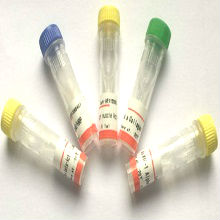
双皮质素抗体试验简介说明
2022-06-21 15:22 作者:洛辰 来源:上海远慕生物试剂
中文名称 双皮质素抗体
英文名称 Doublecortin
别 名 Doublecortex; DBCN; Dbct; DC; Doublin; Lis X; Lissencephalin X; Lissencephaly X linked; Lissencephaly X linked doublecortin; LISX; Neuronal migration protein doublecortin; SCLH; XLIS.
供 应 商 远慕生物
研究领域 细胞生物 神经生物学 细胞粘附分子 细胞类型标志物
抗体来源 Rabbit
克隆类型 Polyclonal
交叉反应 Human, Mouse, Rat, Chicken, Dog, Cow, Horse,
产品应用 WB=1:100-500 ELISA=1:500-1000 IHC-P=1:100-500 IHC-F=1:100-500 IF=1:100-500 双皮质素抗体(石蜡切片需做抗原修复)
not yet tested in other applications.
optimal dilutions/concentrations should be determined by the end user.
分 子 量 49kDa
细胞定位 细胞浆
性 状 Lyophilized or Liquid
浓 度 1mg/1ml
免 疫 原 KLH conjugated synthetic peptide derived from human Doublecortin
亚 型 IgG
纯化方法 affinity purified by Protein A
储 存 液 0.01M PBS, pH 7.4 with 10 mg/ml BSA and 0.1% Sodium azide
保存条件 Store at -20 °C for one year. Avoid repeated freeze/thaw cycles. The lyophilized antibody is stable at room temperature for at least one month and for greater than a year when kept at -20°C. When reconstituted in sterile pH 7.4 0.01M PBS or diluent of antibody the antibody is stable for at least two weeks at 2-4 °C.
双皮质素抗体产品介绍 background:
Neuronal Marker
Doublecortin (DCX) is a microtubule-associated protein expressed almost exclusively in immature neurons. Neuronal precursors begin to express DCX shortly after exiting the cell cycle, and continue to express DCX for 2-3 weeks as the cells mature into neurons. Downregulation of DCX begins after 2 weeks, and occurs at the same time that these cells begin to express, a marker for mature neurons. Due to the nearly exclusive expression of DCX in developing neurons, this protein has been used increasingly as a marker for neurogenesis. Indeed, the levels of DCX expression increase in response to exercise, which occurs in parallel with increased BrdU labelling, currently a "gold standard" in measuring neurogenesis.
Function:
Microtubule-associated protein required for initial steps of neuronal dispersion and cortex lamination during cerebral cortex development. May act by competing with the putative neuronal protein kinase DCAMKL1 in binding to a target protein. May in that way participate in a signaling pathway that is crucial for neuronal interaction before and during migration, possibly as part of a calcium ion-dependent signal transduction pathway. May be part with LIS-1 of a overlapping, but distinct, signaling pathways that promote neuronal migration.

![双[三(羟甲基)氨基甲烷],CAS:6976-37-0](http://struc.chem960.com/strucimg/7000/ctzw0nzi34oyob9fnlmhiwee.png)